

What You Are Actually Investing In
Your Area 2 Farms location is a physical asset that grows fresh organic produce year-round, and the majority of your investment goes directly into infrastructure that lasts for years.
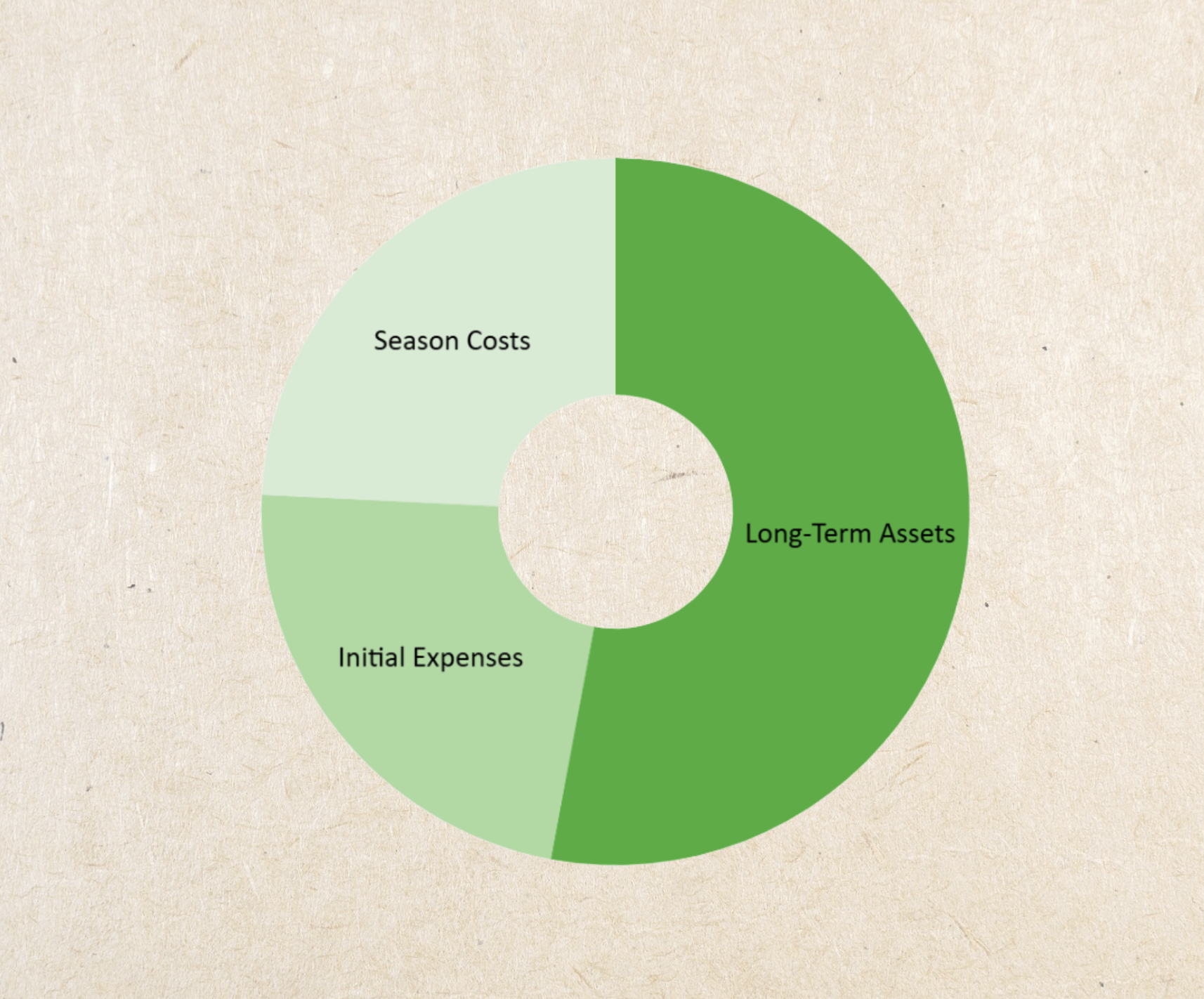
Here is the quick breakdown of the initial $308K - $471K investment required to open an Area 2 Farms location:
A quarter of the initial investment is for one-time costs that are generally associated with the opening of a business, such as licensing fees, rent deposits, and the grand-opening.
More than half of your initial investment goes into the proprietary Silo growing system, which was designed to achieve equivalent or better yields as compared to other approaches, at a fraction of the cost to build and operate.
The remainder covers the first-season’s inputs, such as seeds and soil, and the operating capital required to setup you, your team and your community for success.
Initial One-Time Expenses
Your initial investment covers the practical, predictable costs of opening a business: the franchise fee that brings you into our system, the professional legal and accounting services to set your business up correctly, rent, utilities, and insurance deposits, and focused grand-opening advertising to introduce your farm to the neighborhood it will serve.
Long-Term Asset Investments
The majority of the initial investment is the Silo growing system itself. The Silo is what makes "Move the Farm, NOT the Food" possible: a mechanically simple yet sophisticated platform that allows a productive, year-round organic farm to operate in soil within less than 5,000 square feet, right in the middle of your community. It is the cornerstone of every Area 2 Farms location, and with the right maintenance it is built to keep producing for the long haul.
In addition to the Silos, other growing systems, furniture and fixtures support the daily work of seeding, germinating, transplanting, harvesting, and packing, as well as the community experience when neighbors come through the door. Light construction and leasehold improvements adapt the space to your operation. Interior and exterior signage announces the farm to the street and reinforces that this is not a faceless distribution hub, rather it is a living part of the neighborhood.
Seasonal Operating Expenses
Seasonal expenses cover everything it takes to operate a neighborhood farm and stay connected to the Area 2 Farms system. Cost of Goods Sold (COGS) is everything that touches the crop. Farm payroll sits at the top because the team is the engine of the farm. Then we have the consumable inputs that turn labor into product: seeds, soil, nutrients and fertilizers, integrated pest management, packaging, and the pantry items that round out your members' weekly shares. Rent, utilities, insurance, and general farm supplies keep the physical space running. Local marketing fuels the in-community work of attracting and retaining customers.
Step back from the line items and the shape of your investment becomes clear. Most of what you are investing in is yourself, and the farm, which is a durable, physical growing system you will operate for the life of your franchise. Then you have typical one-time costs of opening your doors, and finally the runway and inputs to get through your first season.
Ready to look deeper? Request the Franchise Disclosure Document today.
Frequently Asked Questions
-
You own and operate a neighborhood farm as critical infrastructure. You're not just "buying a franchise".
You own the farm. You own the customer relationships. Area 2 Farms provides the competitive advantages: organic certification systems, operational technology, brand, and a network of expert peer farmers solving the same problems you are.
-
No, but you need operational fluency. The best Farmers come from backgrounds where execution was the job.
If you've managed a P&L or led a team, we can train the ag-specific knowledge. If you haven't, this will be harder than you think.
-
The economics work because the farm is the distribution. You're not competing on price; you're competing on proximity and quality.
Direct-to-consumer only. No wholesale. No middlemen.Land-as-infrastructure. Farms move to consumers, not the other way around. This solves the "last mile" problem that kills most food businesses.
-
Total Investment Range: $308,817 - $471,000
This covers your franchise agreement, site development, equipment, organic certification, and working capital for the first 3 months.
The exact investment depends on site characteristics and local market conditions. We provide a detailed breakdown during your discovery call after we've evaluated your specific geography and goals.
-
Yes. We insist on it. You need to see the infrastructure, taste the product, and meet the team. This is an essential part of our selection process.